Code Talkers
How language wins wars
CONTEMPLATIONDECODING LANGUAGE
As the Second World War ramped up, countries became unrecognizable, either because they were transformed into weapons factories or because they were bombed until their skylines were flattened.
But wars are not decided by firepower alone.
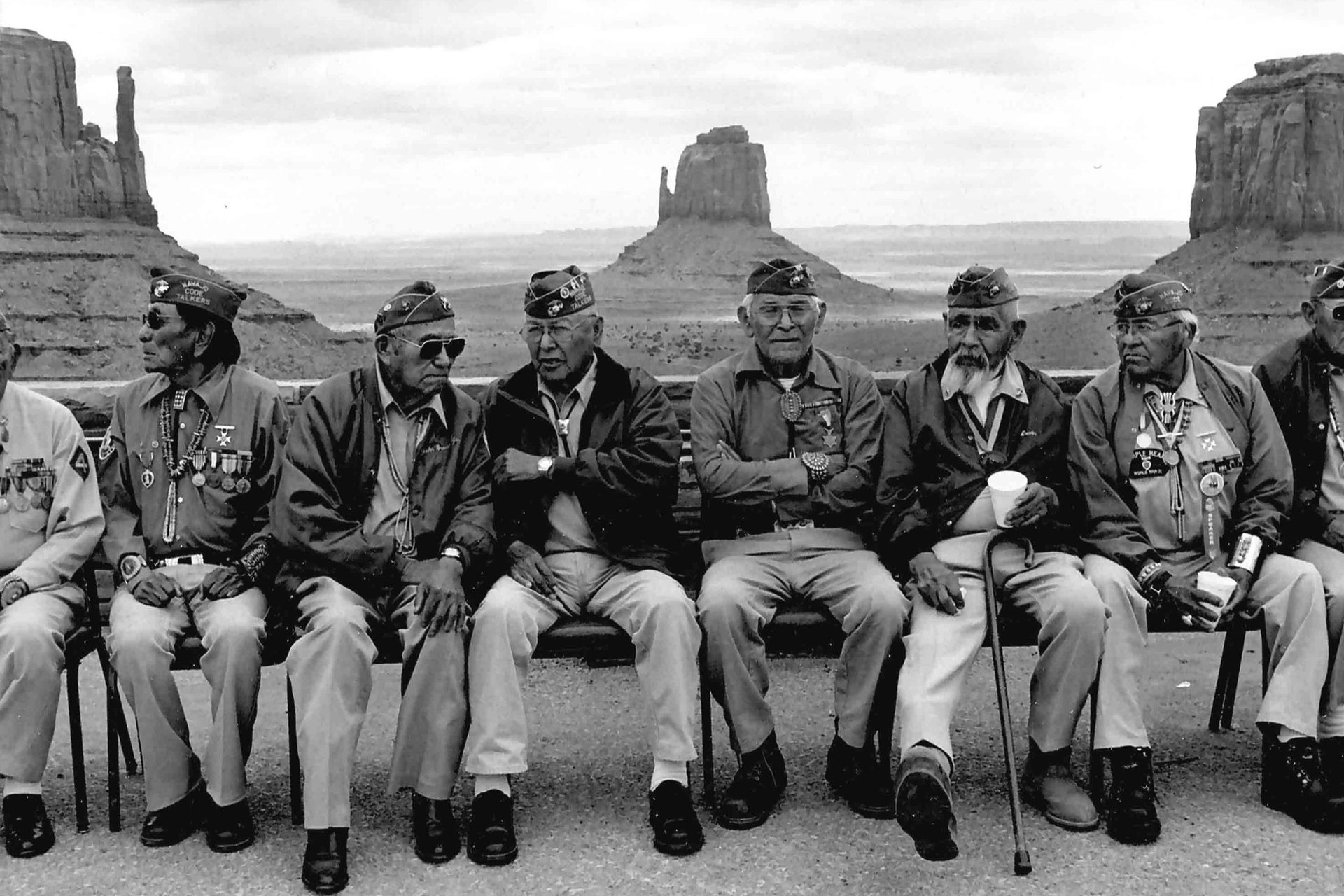
In the Pacific theater of World War II, one specific group of people made a name for themselves – not because of the weapons they wielded but because of the language they spoke. They were the Code Talkers … Cree, Mohawk, Navajo, and several other Native American tribesmen who used their heritage to create a code language that the Axis powers (led by Germany, Japan, and Italy) could not break.
They called submarines ‘Iron Fish.’
Tanks were ‘Turtles.’
Fighter planes were ‘Buzzards.’
This undecipherable language gave the Allies an unprecedented advantage: Their movements became unpredictable to the enemy. Without these Code Talkers, the US advance toward Japan would have been slower and bloodier, or it may have even failed entirely.
In a firefight, guns matter, but sometimes it is the unexpected that gives one side the upper hand…
Sometimes, language wins wars.
It was the unique combination of Native languages, as well as their translation and transliteration into modern alphabets and languages, that created a code only Cree, Mohawk, and Navajo peoples could understand.
The interesting thing is that although the particular code these Natives developed was not understandable to the majority of the world’s population, they were not unique in that they used a code.
Believe it or not, we are all code talkers.
And as crazy as it may seem at first thought, all language is a code. The better we can decipher a language, the more we understand and the better we can share ideas and experiences.
Just like those Code Talkers of World War II, we send and receive coded messages all the time. It is a bit more complicated than that, though.
Let me explain…
Language is communication, but it is not only communication as we typically think of it.
Imagine your mind as a file system. The drawers of this system are filled with folders containing information, images, voice notes, videos, smells, etc., and they are organized by topic. These folders represent the entirety of what you know. If you are a historian, the folders on Ancient Greece and World War I may be filled to the brim, while the ones on nutrition might be rather empty. An athlete, on the other hand, may have many folders on performance and nutrition, but not a single one is allotted to ‘Hannibal’s attack on Rome.’
Language is a system of code that accesses these folders in your mind.
The code is simple at first. In written language, it consists of lines. In spoken language, it consists of sounds.
Written lines bear little meaning. However, as soon as I type two diagonal lines with a horizontal line in the middle, you no longer see meaningless lines. You recognize a code: “A.”
This “A” means more than just three lines. It is a letter. You deciphered that code.
A child who has not learned to read is unable to decipher that code. For the child, an “A” is simply a combination of lines with no further meaning.
Now, what happens when I type “APPLE”?
As you see these straight lines and circles on your screen, your brain recognizes them. The lines and circles make up letters, which in turn form a word. This word calls out the ‘apple’ folder in your mind and finds information, images, voice notes, videos, smells, and recordings about apples.
…Random shapes that I typed called up an image of an apple in your mind. That is why language is a code – symbols mean more than meets the eye to those who know how to decipher it.
Let me now type a different word: “UBHAL”
Again, you recognize the letters. You know it is a word, but it does not open a folder in your mind because none of the folders are labeled with the word “ubhal.” And so, no pictures, recordings, or smells appear.
You can only decipher this code to the level of its letters. Beyond that, you do not understand it.
What happens if I type “μήλο”?
Now, many of you will not even be able to recognize the letters, let alone the word. These codes mean even less to you than in the case of “ubhal.” Now your lack of understanding is similar to the child who cannot read and does not understand the meaning of “A.”
Do you see how reading the written word in your own language is not too different from a coded language that was used to send secret messages in the Second World War?
Only those who know how to decipher the codes have access to their meaning.
Both of the words in the examples above mean ‘apple,’ by the way. The former is Scottish Gaelic, the latter is Greek.
Let us now briefly return to the English example of ‘APPLE.’
I want to add another word to it: “PIE.”
We now have “APPLE PIE.”
Keep that ‘apple’ folder out! Go get the ‘pie’ folder now, too!
But ‘apple pie’ is neither an apple nor a random pie. This is an entirely new thing altogether.
We need an ‘apple pie’ folder!
Now smells of your grandma’s kitchen may start floating through your mind.
That is, in a nutshell, how language works.
These codes do not apply only to lines and letters, though. They extend to phrases, sentences, paragraphs, chapters, entire works of literature, and genres!
An example of a phrase-code would be my line above: “in a nutshell.”
Those who are not entirely familiar with the English language will misunderstand this phrase. They will try to figure out how everything I had written could possibly fit into the shell of a nut.
Those who know the meaning of the phrase, however, likely didn’t even think of the literal meaning of ‘nutshell.’ They immediately understood that this is a common way to express that something is being kept short.
Let’s return to our Navajo Code Talkers from the beginning of this writing.
Why was their code impossibly hard to crack?
Because no one else had the cypher, the key necessary to unlock the mystery of the code.
And if you can’t crack the code, you can’t access the correct folders in your mind to give meaning to the words you are reading.
Read part two here: The world of Emerson, Shakespeare, and John


BE THE FIRST TO KNOW
Join the Chisel&Feather Email List


ABOUT
THE
AUTHOR

VIDEOS & SOCIAL MEDIA
SHARE YOUR THOUGHTS
Navajo code talkers photographed in 2005 at Monument Valley by Japanese photographer Kenji Kawano.
Source: https://www.neh.gov
Chisel&Feather
Copyright© all rights reserved